

There is a moment every person knows intimately: the pause before the leap. The breath before you speak the truth you’ve been swallowing. The stillness before you let someone see the part of you that isn’t polished. Each soul did not come into this life to stay small and safe forever: it came to expand and unfold as it really is here. And expansion and unfolding, by its very nature, asks something of us. It asks us to take risks as a form of emergence into the unknown.
But not all risk is created equal. There is a kind of risk-taking that fractures us, and a kind that forges us. Learning to tell the difference, and choosing the second kind, again and again may be one of the most important skills of a well-lived, soul-aligned life.
What Is Emotionally Healthy Risk-Taking?
Within Edenity, we understand growth not as a straight line but as a spiral. We keep returning to familiar edges, but each time, hopefully, with more consciousness than the last. Emotionally healthy risk-taking is what allows us to keep moving along that spiral instead of freezing in place.
Through the lens of the EBE soul-typing framework, each of us carries a particular soul architecture: a unique way our essence wants to move through the world into form and through our expression. Emotionally healthy risk is the willingness to feel exposed in service of that essence expressing itself, rather than staying loyal to the persona that’s kept us safe but small. It’s rooted in self-trust rather than self-abandonment. It says: I may not know how this will land, but I feel who I am while I do it and it comes from trusting my realness and aliveness.
This kind of risk doesn’t require certainty. It requires presence. A willingness to stay in your body, in your integrity, and in relationship with your soul’s evolutionary impulse, even as you move into the unknown.
Ego Isn’t the Enemy: Green vs. Gold
It’s worth pausing here to clear up a common misunderstanding. In Edenity, ego is not a dirty word. Ego is simply the relationship self has with self, or in other words the inner structure through which you meet your own experience internally and externally. Everyone has one. The soul needs it; it’s the vehicle through which essence learns to express and move in form.
The real distinction isn’t ego versus no ego. It’s which version of ego is at the wheel:
- Green ego (egi) is the protector. It formed to keep you safe, often a long time ago, and it does its job by contracting: controlling, dominating, avoiding, performing, and defending. Green ego isn’t bad; it’s a younger part of you still doing its best with old information, a loving act of service to self that can’t transact real bandwidths of love. But when green ego drives your risk-taking, the risk becomes reactive rather than expansive into more realness.
- Gold ego (ega) is the soulful adult self. It’s still ego, still a relationship self has with self, but one that has matured enough to hold uncertainty without collapsing into fear or fusion with control. Gold ego can feel the fear of a risk and take it anyway, not because it’s fearless, but because it trusts itself and life enough to meet whatever comes.
Healthy emotional risk-taking is gold ego in motion. Unhealthy emotional risk-taking is usually green ego in disguise, dressed up as boldness, but actually still driven by the old need to protect, prove, or escape.
Healthy vs. Unhealthy Emotional Risk-Taking
Both kinds of risk can look similar from the outside: a hard conversation, a bold decision, a vulnerable confession. What separates them is which ego is steering.
Emotionally Healthy Risk-Taking (gold ego, essence-led) looks like:
- Speaking your truth even when your voice shakes, because staying silent costs you more than being heard
- Setting a ‘boundary’ (read as making a choice in relating) from a grounded place, not from resentment that’s finally boiled over
- Sharing your authentic feelings with someone, with no guarantee of how they’ll respond
- Trying something new because your soul is calling you toward growth, not because you’re trying to outrun something
- Staying present with discomfort instead of numbing, fixing, or fleeing it
- Choosing vulnerability as an offering from your essence, not a plea for rescue or approval
Emotionally Unhealthy Risk-Taking (green ego, protector-led) looks like:
- Blowing up a relationship or situation impulsively, as a way to avoid the slower work of repair
- Oversharing as a bid for validation, attention, or to manufacture closeness before trust has been earned
- Taking action from a wounded, reactive place like proving a point, punishing someone, or seeking to be “right”
- Chasing intensity or chaos because calm feels unfamiliar or unsafe
- Abandoning your own needs or values to keep the peace or avoid conflict
- Leaping without any grounding, driven by the protector’s need to escape rather than the soul’s evolution
- The line between them isn’t the size of the risk. It’s which relationship-with-self is doing the choosing: the protector trying to manage the outcome, or the soulful adult trusting the process.
A Personal Turning Point
I know this terrain from the inside. For years, I performed a version of universal love: showing up as the steady, giving, unshakeable one for everyone around me, while quietly avoiding the far riskier work of letting anyone actually see me. I called it patience and equanimity. It was control. I had built what I now recognize as a green protector pattern, one that kept my nervous system safe by keeping my heart just out of reach.
It worked, until it didn’t. When that pattern finally collapsed, it wasn’t tidy or graceful. It was the real risk arriving all at once, uninvited. But on the other side of that collapse was the first taste of genuine intimacy I’d ever let myself have. I wrote about this collapse in my book, Angelman, because I believe naming it might spare someone else years of performing love instead of risking to open up to receive it.
Risking the Unknown, Again in Europe
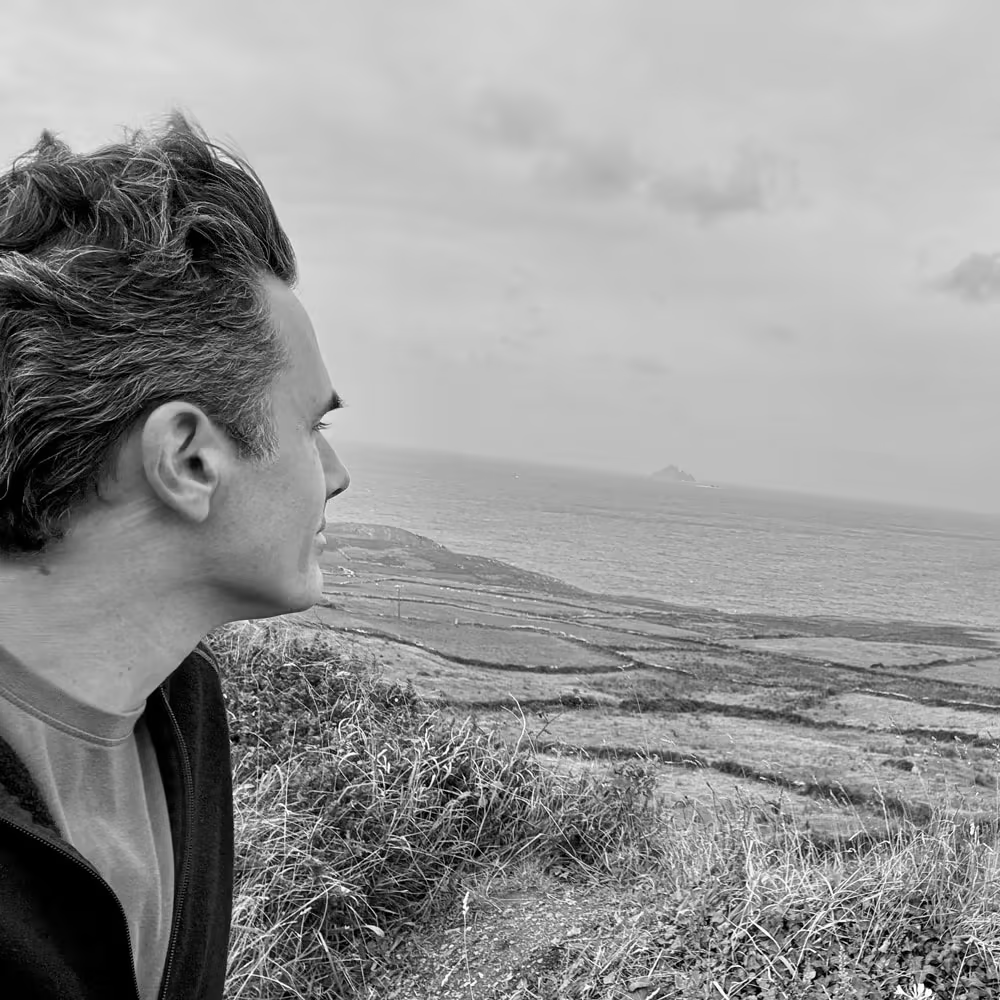
That same edge showed up again this year, though in a gentler, more chosen form. I recently spent 62 days traveling through Europe: Germany, Switzerland, Bavaria, Freiburg, Copenhagen, Barcelona, southern Spain, Portugal, the Canary Islands, and Ireland with no fixed script for who I’d be along the way.
Some of it I did entirely alone, which meant no one to perform for and nowhere to hide from myself. Some of it unfolded on a retreat, in the kind of container designed to lovingly relate with and dissolve the protector’s usual defenses. Some of it I shared with close friends who already knew me, and some of it I shared with someone new I’m getting to know, which meant risking vulnerability in real time, with someone who didn’t yet have years of trust built up with me.
Each of those contexts asked something different of my ego. Solo travel asked gold ego to hold its own company without the protector filling the silence with distraction. The retreat asked me to let go of control entirely and trust a process I couldn’t manage from the outside. New places asked me to be a beginner again and again, unfamiliar with the language, the streets, the customs, uncomfortable in the most fertile sense of the word. And opening to someone new asked the most tender risk of all: to be seen before certainty existed. It was such an adventure and I had so much fun and I really grew as a result.
What made it an emotionally healthy risk, rather than just movement for movement’s sake, was the orientation underneath it. I wasn’t running from my life, I was letting my life expand to meet me. And the real work wasn’t the travel itself; it was coming home and weaving what unfolded: the new person, the deepened friendships, the version of myself who unfolded in Copenhagen and the Canary Islands, back into my existing relationships and daily life, rather than leaving it all behind as a separate, compartmentalized experience.
That weaving is where gold ego does its quiet, essential work: integration. Not “I had an adventure and now I’m back to normal,” but “I am different now, and my life is becoming different with me.”
Why This Matters for Your Long-Term Growth
The soul does not grow in the comfortable, well-worn grooves of the familiar. It grows at the edges, in the places where we don’t yet know who we’ll be on the other side.
If we only ever choose the unhealthy version of risk, we mistake chaos for change. We create movement without transformation, the same patterns wearing new costumes. But if we become too risk-averse, avoiding all discomfort in the name of “safety,” we quietly calcify. The soul’s evolutionary impulse gets buried under the protector’s need to feel secure, and we begin to shrink into a smaller version of who we came here to be.
Emotionally healthy risk is the bridge between those two extremes. It is how integration actually happens, not by avoiding the edge, and not by leaping recklessly off it, but by walking toward it consciously, again and again, letting gold ego take the wheel a little more each time, until the parts of you that were once afraid become fluent in trust.
Every healthy risk you take is a message to your own emotive and nervous system, your own essence: I am safe enough within myself to meet the unknown. Over time, that message compounds. It becomes the foundation of a life lived in expansion rather than contraction, a life where your outer choices finally start to match the depth of who you actually are.
An Invitation
The next time you feel that familiar flutter, the pull to say the true thing, try the unfamiliar thing, feel the vulnerable thing. Pause and ask yourself: Is this my protector trying to manage the outcome, or my soulful adult self trusting the unknown? Is this risk moving me toward my essence, or away from it?
That single question can become a compass. And every time you follow it toward growth rather than escape, you are doing something sacred: you are letting your soul lead.